
Talk to an expert
Work/Nutri Advanced
ReplatformHealth & wellnessCW-085-RP-HW

Nutri Advanced: rebuilding health and wellness around catalogue depth and account buying.

A 6-month replatform for health and wellness, shaped around catalogue depth, account ordering, technical product information, stock and pricing logic and B2C, B2B2C and Retail buying.

Nutri Advanced's operating scale meant the commerce platform had to support specialist catalogue depth, operational systems and account buying without losing customer confidence or continuity.

6
Month project
Kickoff to go-live
5
Platforms
Adobe Commerce, Adobe Analytics, Adobe Target, Word Press CMS +1
5
System integrations
Subscription Renewal, Multiple Commerce Sales Channels, Microsoft Dynamics 365 Business Central, Custom Order Management (OMS) +1 +1 more
3
Commerce models
B2C, B2B2C and Retail
Read onWhat was actually wrong, what we did, and what could have gone wrong.
02
The problem

What was actually wrong

Nutri Advanced needed a commerce platform that supported the Health & wellness business model and the trading patterns of its customers.

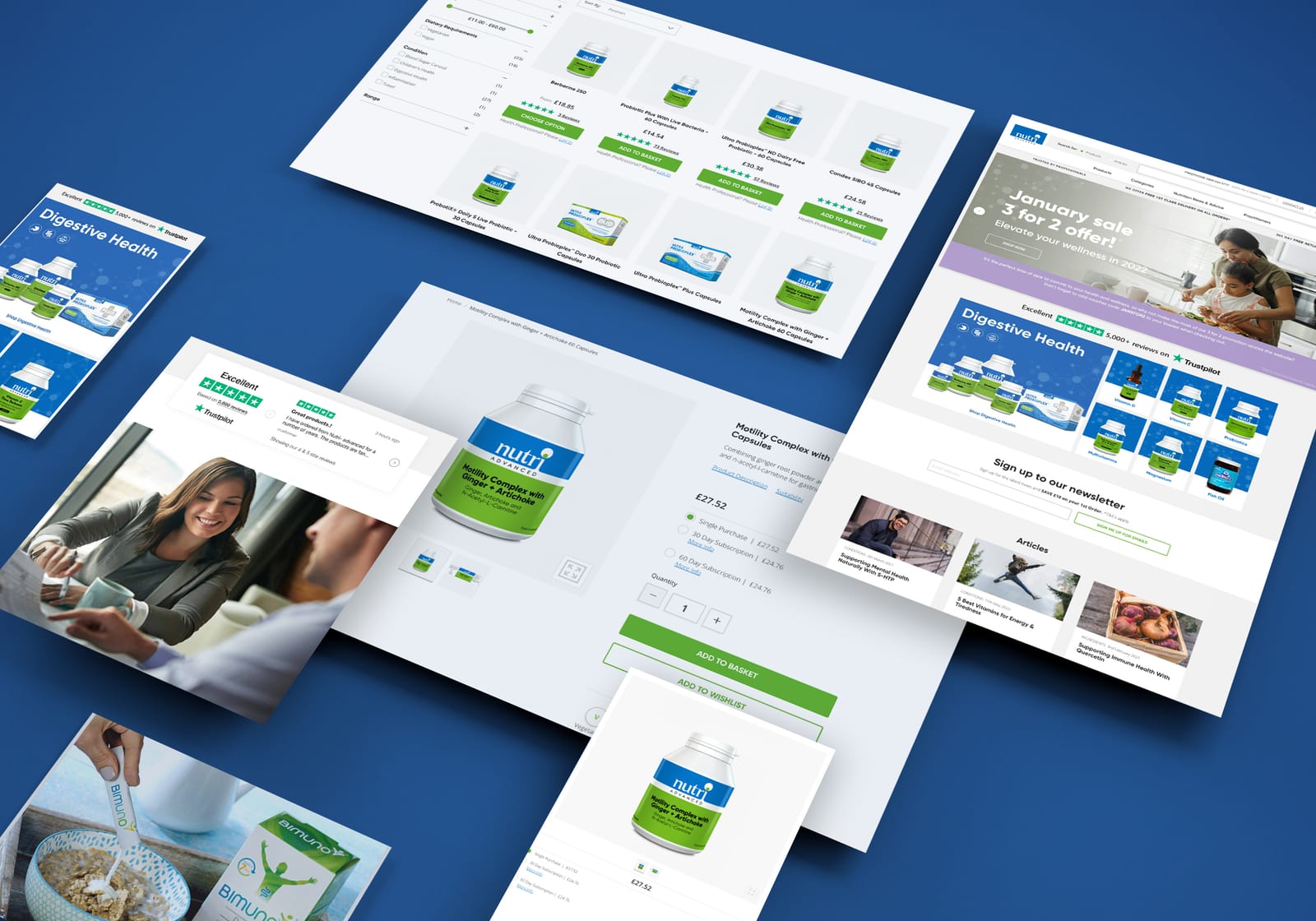
This was not a brochure storefront. Buyers arriving for a specific item needed enough product information and context to identify it with confidence, while stock, account pricing and purchase history had to support the same buying decision.

Order flow, stock and customer data crossed several back-office systems, so integration boundaries and operational handoffs likely shaped how the platform was built.

Stock was not one flat number. Depot location, availability and fulfilment context had to remain meaningful so customers and order teams could rely on what the platform showed.

Business customers also needed the platform to reflect how they buy: parent and child account relationships, repeat purchase, order history, account documents and the correct pricing and stock context.

The commerce layer had to sit cleanly alongside ERP, without turning every operational dependency into a launch risk.

03
The risk

What was at stake

Unclear product, pricing or fulfilment information can create friction before an order is placed.

Most relevant to Health & wellness teams weighing similar platform decisions.

If catalogue and operational data drift, buyers can lose confidence in product information, pricing, stock and purchase history. That can delay or abandon an order, while internal teams absorb the uncertainty through manual checking and customer service.

For repeat buyers and trade accounts, uncertainty creates friction every time an order is placed again. Wrong-part risk, unclear account terms and a harder repeat-order path can frustrate buyers and move the burden back to account teams and support.

Once a buying habit moves elsewhere it is expensive to win back. The consequence of inaction is not dramatic; it is cumulative.

04
The work

Five things, in order.

  1. 01
    Mapped the buying journey before the interface
    Started with how customers actually order on this site, then let the journey shape the interface decisions, not the other way round.
  2. 02
    Rebuilt the commerce foundation around how the business operates
    Rebuilt the commerce foundation around the operational logic the business already depended on, without resetting what already worked.
  3. 03
    Connected the systems that the storefront cannot work without
    The commerce layer had to sit cleanly alongside ERP without coupling the launch to every system on day one.
  4. 04
    Scoped the rules per audience, not per platform
    Account-led ordering and self-serve buying were shaped as distinct journeys on the same foundation. Local catalogue, depot, inventory, delivery and pricing rules had to remain coherent for the buyer context in front of the screen.
  5. 05
    Moved the project into support with the operating context intact
    Handover preserved the operational decisions made during build, so support could keep moving the platform forward without re-learning the business.
05
Systems

Platforms and integrations

The customer-facing platform was one part of the operating system. The project also depended on operational data, product information, inventory and communication systems, with clear boundaries for what each one supported and what customers could rely on.
Adobe Commerce (Powered by Magento)
Customer-facing commerce platform
Provided the customer-facing commerce platform for catalogue, account and ordering journeys. The platform could only present information it received from the operational and product systems around it. It mattered because a mismatch could become visible through product, account, stock or order information.
Multiple Commerce Sales Channels
Connected operational dependency
Supported the Multiple Commerce Sales Channels connection within the commerce operation.
Microsoft Dynamics 365 Business Central
Operational business data system
Provided operational context for account, order, pricing and fulfilment data used by the commerce experience. Commerce depended on an agreed boundary between ERP-held business data and the customer-facing platform. It mattered because a mismatch could become visible through product, account, stock or order information.
Adobe Target
Experience optimisation platform
Supported the experience optimisation layer within the project platform stack. Its role depended on a clear boundary with the customer-facing experience. It mattered because a mismatch could become visible through product, account, stock or order information.
Word Press CMS
Experience platform
Supported the experience and content layer within the project platform stack. Its boundary with commerce and connected content flows needed to remain clear. It mattered because a mismatch could become visible through product, account, stock or order information.
Adobe Digital Experience
Project platform
Supported the digital experience layer within the project platform stack.
Custom Order Management (OMS)
Order management integration
Connected order management as part of the operational flow around commerce. Order journeys depended on a clear handoff between the customer-facing platform and order processing. It mattered because a mismatch could become visible through product, account, stock or order information.
Adobe Analytics
Supporting platform layer
Supported the Adobe Analytics connection within the commerce operation.
Retail Syndication
Connected operational dependency
Supported the Retail Syndication connection within the commerce operation.
Subscription Renewal
Connected operational dependency
Supported the Subscription Renewal connection within the commerce operation.
06
Risk control

Difficult parts

ERP dependency
Account, order, pricing and fulfilment data depended on the ERP boundary. A stale or ambiguous hand-off could surface as the wrong account context, order state or delivery expectation. How we held it: Define which operational fields the ERP owns, how commerce consumes them and how failed or delayed exchanges are identified before they affect an order.
Platform maintainability
Commerce and digital experience capabilities sat across more than one platform. Unclear boundaries could make routine change harder and allow overlapping ownership to create inconsistent behaviour. How we held it: Keep platform responsibilities explicit, document the joins and carry those decisions into support so future changes do not reopen settled architecture questions.
Account ordering
B2B and direct buying shared a platform, but account hierarchies, purchase history, documents, pricing and order paths could differ sharply by buyer. How we held it: Model account relationships and permissions explicitly, then test repeat-order and self-serve journeys against the correct customer, price and document context.
Timeline
The recorded project length set a fixed delivery context for a broad platform and integration scope. How we held it: Sequence decisions around the highest operational dependencies and flag any scope trade-off for editorial review rather than claiming an undocumented method.
Stock and pricing
Availability and price could vary by account, catalogue, depot or inventory source. A flattened view risks presenting a value that is technically current but wrong for the buyer in front of it. How we held it: Preserve the buyer and location context behind stock and pricing, define the source for each value and test how fallbacks behave when an operational update is late.
Support ownership
After launch, unclear ownership across parts data, pricing imports, inventory feeds and account behaviour could make operational faults slower to understand and resolve. How we held it: Carry the system boundaries, data ownership and recovery decisions into support so the team inherits the operating model as well as the platform.
07
Outcome

Results

6
Month project
Kickoff to go-live
+65%
Of revenue from search
Improvement recorded after launch
5x
System integrations
Subscription Renewal, Multiple Commerce Sales Channels, Microsoft Dynamics 365 Business Central, Custom Order Management (OMS) +1
+165%
Purchases on mobile
Improvement recorded after launch
5x
Platforms
Adobe Commerce, Adobe Analytics, Adobe Target, Word Press CMS +1
+180%
Page load times
Improvement recorded after launch
08
Client feedback

In the client's words

iWeb created a meaningful user-facing digital experience that can be utilised by consumers and health professionals to provide inspiration, deliver additional product information, and guarantee exposure to a broad product range.
Jenny Patman, Head of Marketing and Digital, Nutri Advanced
09
After launch

Ongoing support

The project did not end when the platform went live.

Support mattered because the health and wellness still depended on parts data, pricing imports, account behaviour, inventory feeds, integrations and customer-facing information after launch.

Keeping the build decisions and system ownership visible gave the support team a clearer basis for tracing issues and maintaining the connected trading system after launch.
Next step

A project that looks like this one?

Send us the brief. You'll get a written response from a senior expert, usually within two working days.